Thursday, 17 December 2009

fodder figures


The use of fodder to make grass figures by children is slowly taking on.
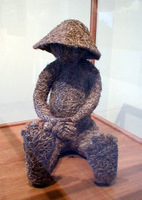
Today I have been shown a small figure made by Hunter who is 7. (see picture here)
Hunter stitched straw into a small person shape then he cut material to make clothing. The eyes are buttons and different coloured wools are used as feet coverings and a head band. His grass figure is carrying a spear. Perhaps he means it to be an aboriginal hunter.
Children at Mooditch School are now skilful a with stitching grasses and reccycled textiles. Aged from 5 to 12 they have sewing skills, Fodder in its way of enjoyment encourages this.

Thursday, 11 June 2009

A group of high school students here in Midland have almost completed making an Aboriginal flag of a sorts from fodder.
approx 20 students gather each thursday morning and they have stitched two large sheets of grass which today were joined upto become one.

It is worked onto a sheet of chicken mesh , each sheet is 150 x 100 cm so now thye they are joined it is quite impressive. A sun, a man with a spear and smaller figures that represent the Souther Cross stars. The Torres Strait Islander flag has been made and that is stitched on also.

Initialy I had doubts that it would work as it is quite heavy but having the wire base, plus sticks have been lashed along the sides and it looks good.
The students have had much fun making it. It will be ready for NAIDOC week shortly.

I think this may be the first time ever that grass, fodder has been used in such a manner.

Sunday, 21 September 2008

generations


Recently at the Indigenous Moorditch School here in Middle Swan we had a series of fodder classes with teacher Todd Israel and a group of assistants..
Amongst the very lively group was Joyce Winsley's son who is the cross cultural co-ordinator for the school and his daughter, (Joyce's grandaughter) both making grass figures. Father made a series of men and a kangaroo using grasses (fodder ) and cloth and wool. Daughter made an emu using fodder and wools.
He is going to show the boys at the school how to make figures. It is very exciitng and wonderful that a senior man has developed these powerful small figures.
He already plans to make a whole series and is up to number 7 now
His mother would be very happy for him...

Saturday, 28 June 2008

Local abundance.


Three small stories.
Well 33 on the Canning Stock route. Kunnawaritji, this remote community, recently held a gathering of womrn to further develop the Canning Stock Route Project. Grass basketry was on offer as a diversion from painting. Local grass was harvested from the dry dune country. However the women did source and use discarded meat pie tins as bases for their baskets.
At the well itself, there is a large water hole thickly banded with a type of juncus, a long narrow pliable leaf. This would be a sustainable basketry material as it could be cut off with a knife at the base rather than pulled as the grass is.
After four days making there was a colourful collection of baskets using the holed meat pie tins as bases.
Further south in the wheatbelt, the source of fodder, the Nyoongar commumity of Badjalling held a small festival.
This is quite nearby Joyce Winsleys country.
i hoped the women may be intersted in fodder.However it was the young people who cut the strings on the bale of meadow hay and spent the day making grass manguries, fibre circles wrapped with recycled textiles.
In time perhaps some of the local women will be drawn to making fibre craft works from their abundant supply of sustainable materials.
Following Badjalling a group of indigenous women from Carnavon have established themselves as basketmakers. They have been collecting grasses from the land, grass which is tough and quite difficult to access.
Carnavon is bananas, enormous plantations line the banks of the Gasgoyne river where it enters the sea.
For this group of women to use the trunks of banana palms seemed such an obvious solution.
So the trunks were collected and dissected longways into quarters. These were dried over 3 months or so. Then during a weeks workshop the women made baskets and fibre sculpture with the dampened strips of banana fibre. It is soft and malleable and a pleasure to handle. Wool and recycled textiles were used for sttitching, weaving etc.
It is a sustainable and local material.
These three events show how I am very gradually trying to encourage use of sustainable fibre and recycled materials.
Previous to each of these events I held a workshop in Hobart where we also used fodder, the women involved had great fun for 4 days and eagerly divvied up the leftovers to carry home.

Friday, 25 January 2008

Fodder figure's


These small figures have been made by children during a Todd Israel workshop.
Fodder fibre is used for the foundation and then it is dressed/ decorated using recycled materials to become a puppet.

Sunday, 20 January 2008

Other materials for making


The hair arrangement by the newly married zulu woman... by understanding structure and looking carefully I was able to work out how it was constructed and maintained and I stand corected if it is not so.
The question ,'what other materials may be available to use' . The craft consumer in South Africa has been trained to expect refined, well made objects whether it be a telephone wire basket, a straw broom, a carved animal or an exquisitely beaded necklace .
Not only do the consumers but also the makers have the same high standards of what craft should aspire to.
The use of 'feral' materials, and there will be some, takes a long time to explore and then 'tame' to a standard of acceptance.
At the Phansi Museum in Durban there are original works that were used within a culture. Many of those pieces were quite freely constructed, not necessarily made to last and certainly using much recycled material particulalrly textiles..
If the contemporary makers were able to view those collections then I feel that they may percieve other materials which could be used.
It would be wonderful if an exhibition of such objects could be taken on a mobile tour to villages where the makers could have a very close look at them, even handle them. Many people will never have seen the older crafted objects in a non confronting enviroment.
This would lead to exploring materials which may not have been considered, particularly manufactured materials.
It seems hard to imagine any materials that have not yet been eyed off.
However there in the Drakensburg the women had not shredded up mealie bags which have endless thread in them so it is possible.
In Australia we have hardly scratched the surface in the use of fibrous materials from recycled sources for making. Happy days to come.
The image is Heather's cloak made from hand made string of red hot poker leaves then the string was netted to a cloak. shape.
Corn husks could be used in a similar manner.

Friday, 11 January 2008

'inhoko' unravelled?

The mystery of the 'inhoko' is that the woman's hair is carefully braided and extended then the globular arrangement is established. Finally the supporting bands circle the stem of the enormous bulb. As the womans hair grows another band is added to support and incorporate the new growth.
Any curls which grow free of the arrangement are plucked out hence the hairless area above the forehead.
It would give its owner an amazingly strong neck for life.
I am wondering if it is also used to contain small treasures.
The wearing of beanies by many of the Australian desert women is both for comfort and a place to store money.
NMS.

Thursday, 10 January 2008

sustainability?=corn husks


Thanks for those thoughts on hair. In New Giunea certain men make a whole head of hair from their plucked and saved hair and then it is worn on special occasions. It indicates a certain level of maturity and access to mens rituals. It fits on the head like a bycycle helmet and it probably just as protective.
It is often hightly decorated with colourful flowers, feathers, fruit, anything at all.
Live hair carries the power of the wearer but once it has become detached from the owners body then it takes on meanings of extremes. This image is a hair vessel using 18 years of saved hair and stitched with fine linen thread.
However corn husks which should be abundant in South Africa given that corn is the staple are a very sustainable fibre.
The husk is peeled and dried then it can be dyed or left natural, then shredded into working strands 2 or 3 centimetres broad.
Dampening it for use makes it easy to manipulate.It is equal to any other fibre and cost would be zero.
Perhaps it is already in use but I did not see it as such. I have suggested to Hlwenge Dube to encourage some of the women to experiment with it. Women crafters in Soweto would have access to corn husks and mealie bags for stitching.
Native American women have used corn husks for baskets, masks and other paraphanalia for generations.
So perhaps we will see more corn and less husks in the near future.
Meanwhile it has been a bumper year for Fodder after the drastic shortage of it last season and I am about to collect some high quality bales from a farmer in the south.

Hair and there

Sorry, Nalda, for not responding in recent times. Now that I'm out of Craft Victoria, I have a little more freedom to follow this interesting train of thought.

It seems that one of the marvels of fodder in South Africa was to be able to make art from a material so easy to access. This is a strong feature of art and craft in southern Africa.

What other materials might nature provide? I was talking with Hlengiwe Dube about the Zulu attitudes to hair. She told me about the remarkable practice of Zulu women on marriage to have their hair woven into a headdress (inhoko), which is kept for life.

I was talking about this to my hairdresser today. She was saying that all hair, regardless of race, must grow. So I wonder how this is maintained over time?

The inhoko has now evolved into an artificial headdress. The particular weaving structure has developed from the way hair was braided.

This evolution makes you think how various hair crafts might translate into other artificial materials.

Just around the corner from me is one of the many African hair braiding shops that have opened in recent times. Perhaps I should ask them?

Monday, 5 November 2007

Fodder aound the South.


Melbourne Victoria Australia, Moora Western Australia and Johannesburg South Africa, have all been sites for grass fibre (specifically bales of fodder) weaving workshops in the past few months.
The images show the workshops along with a fibre piece from each..
As common as fodder is never the less it allows great freedom in the making.
In Melbourne it was sourced from a stockfeeder supplier, in Moora directly from a farmer and in Johannesburg the Zoo kindly dontated a bale and we hope the elephants didnt go hungry on our behalf.
At each workshop without exception there is an energy and excitement as people venture into a form and it slowly evolves.
In Johannesburg Ivy Hopkins from Central Australia was present and she collaborated with others in making a large figure using raffia, wool and fodder. I think the particpants were intrigued as the child sized figure took shape with such spontaneous action.
I asked a young man what he wanted to make. "A lion" he rplied and set into it. Later I saw him back making a basket.
May the shared materials and company contribute to the important linking of Southern Hemisphere crafts.
Nalda Searles

Monday, 16 July 2007

The myth and fodder amonst other things

What does it take to sew a myth (fictitious narrative) into being using not just fodder but any materials?
How does an artist decide what may be a potential myth, can an artist make such decision ?
I am reminded of looking into a kaleidascope,(beautiful form) when ones sees a particular configuration and it fleetingly impresses and then disappears, ever elusive and yet somehow convincing.
Its shade or memory has left something behind. Then slowly the mind pads up that shade, it changes shape, changes even its meaning but it carries a constant cord which turns itself into a spiral. A transformation has taken place.
Here becomes the spiral of journey. there are endless wayside stops, any of them can yield up a myth if that is the intent.
No matter what the form of the outcome if it touches a dreamer then it potentiallly is a myth.
If the large grass figures the Western desert women are making represent mythological characters then there is a clear example of making a myth visual.
I mean even though everyone knows Wati and Minyma Patjata exist in the ranges around Blackstone (Papalunkutja) until now they had never been seen in human form. Now they have.That is amazing. A ancient myth has made a visual contemporary entrance into the world. (And grass at that)
Sometimes I think the pieces of clothing I make have the potential to contain myth. For instance the xanthorrheoa dress made 1996. It has never lost its visual strength and as it moves further away from my making it takes on it own presence which that dreamer may interpret as myth.
I recall some years ago displaying the dress laying gently on a table which was covered with a length of plant dyed gold silk. An anglican priest came by and stood looking at it for a long time. He was seeing a myth in it, he was a dreamer.

Tuesday, 19 June 2007

Conservation or compost


The combination of clay (earth ) and grass (plant) in artworks is ancient, perhaps even basketry predated the firing proess of clay.
From time to time one sees examples of makers combining the two materials. To do so and create a harmony and balance without being contrived is elusive.
To marry the mediums so that the clay gives birth to the grass and the grass therefore grows out of the clay sensitively is important. The outcome should speak of growth not construction.This bird alighting from a waterhole combines clay, fodder coiled with silk and cotton and a found wood fragment.
The women from Jigalong made a series of baskets combing meat pie tins and fodder stitched with coloured wools.The distinct form of the pie tins easily linked with the bold coiled stitches.They were clearly construction but suceeded because of their visual strength.
The nature of fibre construction using fodder is so adaptable to form that the women making nanduti would find it easy to make their flower forms.
Perhaps they may read Fodder and be encouraged to experiment.
The type of stitching more or less controls the form and surface. The more informal the process the more ability to shape quite faithfully to form.
The idea of grass flowers is quite intrigueing.
Being able to handle clay and fibre more or less in the same breath is very liberating.
For the most part they are kept quite separate as mediums, which would not have always been the case of course and in many cultures still is not. The most obvious is dwellings combining straw and mud.
This is where conservation or compost arrives. Fired clay can be washed but grass cannot.
However most fibre providing it is kept dry and not stressed will last for many years. If it functions as a container then definitely it has a life span.
It is the stitching threads which give way rather than the fibre breaking down. For example Seven sisters grass figures have an array of fibres holding all that grass together and will need to be checked from time to time.
Probably 99.9% of fibre construction simply becomes compost, its that .1% that we must care for.

Monday, 11 June 2007

Fine rubbish

 What a wonderful post Nalda. It's very exciting to hear about the introduction of clay to the grass work.

What does it feel like? I imagine there's quite a contrast between the hard ceramics and the pliable fibre.

The story about the precious 'rubbish' hay is wonderful. If anything, the work that you are doing is a way for others to have a better material understanding of how the land operates, and so how the lamb chop appears on our plate every evening!

I've  just posted a short notice about women who make ñanduti in Paraguay. There will be a longer piece in Craft Revival Trust soon. They are quite expert in the needle and it would be very interesting to see how they could adapt to the kind of materials that you are using.

One issue that must always dog your work is conservation. Fibre must have different qualities of durability. But I imagine that fodder is particularly ephemeral. Do you find this to be the case? Are there ways of making it last longer? Or alternatively, are there ways of making something out of its fragility?

Tuesday, 5 June 2007

grass as fodder as grass


It seems that the use of fodder is dependant of supply from stockfeed outlets at present so I am endevouring to encourage its use at least where it can be sourced.
For instance a week in Blackstone for the 4th Blackstone Festival and the women collected grass from land to use for their basketmaking. Raffia was dyed using plant materials, barks and leaves boiled in half 44 gallon drums cut lengthways with a fire underneath, also an electric copper appeared so very successful sessions.
There was a fabulous collection of grass dogs made, all shapes and sizes, bound up with colourful wools and raffia.
Once again we introduced raku clay with the idea of using fired clay bases for basketry. A kiln was built using materials sourced from the tip and as houses are being constructed in the community there are pine pallets to burn literally. It took 40 sawn pallets to fire 32 kgs of clay for 11 hours. Here is a photo of small piece combining the two mediums made by Ivy.

However here in the city 12 women gathered last weekend for a workshop and made short work of a bundle of fodder.
When I went to the stockfeeders for a bale there was no meadow fodder just oaten hay in a huge haystack. The man pulled out a bale to give me but I went looking very closely at the stack and found one which had fine fibres in it, I asked the fellow for that one, 'Thats a rubbish one" he said disdainfully. Meaning there was less hay and more grass in it.
For the women sewing it was manna.

As an overview it is the combination of recycled materials mixed with domestic grasses ie. fodder, which can be considered a succesful and sustainable practice. However what choice can there be in a location where even fodder is at a premium, Where recycling for art and craft is already so efficient.And yet the combination gives so much scope for individuality.
That collection of dogs at Blackstone was so full of variations yet each maker more or less used the same materials.
that is what intruduces humour and the great pleasure of making.

Thursday, 12 April 2007


Other grass artists....
After a break wherein I visited Jigalong, a remote community and we took several bales of fodder with us to workshop the women in the use of sculptural forms, Kuka baskets using discarded meat pie tins and grass stitched with coloured wools, goannas, snakes, and a small figure to mention some were made. The picture here is of Kumpaya making a kuka basket.
To answer you’re previous posting.
The fodder is actually a mown grass, a mixture of rye, an introduced species, sometimes clover and often capeweed. The lengths vary from several centimetres up to perhaps 30 cms and it is scraggy. Impossible to pluck out a collection of smooth materials as both Joyce and Katie use.
Fodder is more like a stuffing of sorts.
When Joyce started to work with grass in 1988 she became very excited. It was several years before she planned on her meat safe, and this I think, which was followed by her arthritic arm and frilled neck lizard etc is how she arrived at the Mamurie man. He was her first figure using Guildford grass sort of rolled and crushed and built up slowly. Beyond Mamurie man her family of figures just kept on coming. Joyce would think about what she wanted to do for quite a while, planning how to construct, perhaps this happened whilst she was still working on a previous one. Stitching grass certainly gives plenty of thinking time once the form is right.
The spirit of life was in every piece of her work, because each came to life from her memory of that person as she recalled them. From our many conversations her making was cathartic and there would have been many more coming after the Didgeridoo player, her final piece, I have no doubt.
Kate Campbell Pope, the most sensitive of all fibre artists has made few baskets as such. Her use of many plant materials, grass, bark, twigs, and leaves are most often stitched into intricate sculptural forms associated with both the body and emotions. .
The hand/ mandala pieces she made for ‘recovering’ in 1997 were beautifully crafted.
A layer of grass as a base with a negative hand shape worked into it and then a positive grass hand protruding from the base. Around the edges of the complete tiny grass flames/ leaves gave a wonderful sense of life. Kate has kept making these exquisite fibre forms of the inner and outer human. She stretches grass across delicately made structures often wrapped and stitched with silk.
I have certainly learnt much from both Joyce and Kate, perhaps more conceptual rather than material wise. Kate and Cecile Williams, both close friends inspire me continuously.
My passion for mixing plant materials to give texture and the effect of land seemed so important for so many years. The use of grass alone was not appealing as such though I did do numerous pieces in the early and mid 80s.
I put my work into an Australiana context rather than a contemporary one perhaps.
Now of course, in the past 10 years grass has become the lingua franca for fibre art. In its neutrality it can be so well manipulated.

I think you are correct in saying it seems to be an Australian pursuit at present, but I doubt it will stay that way for long. I know Sandy Elverd from Adelaide taught a fibre workshop in America last year so Sisters will have found its way there. Perhaps in India there would be similar grass artworks being made, that would come closest to these here.
However here it is cheeky, surprising, sensitive and running like wildfire. The bottom line is of course when it will even out, we are all having so much fun inventing that we also need to consolidate, You may have heard that Kantjupayi has made a kids Toyota recently, its amazing, all colours and grass. After the big one, that is consolidation!

Yesterday I was shown a swan/duck? Made from grass and old chair upholstery materials, so much character and life in it as if there are swans like it just flying around everywhere, The fact that the maker could visualise that bird, have the materials at hand, and then do such a fine energetic job on making it with so much charm stuns me. What’s more it is probably the only one in the whole world, which will ever be made like it and it came from a remote desert community just to top it off.
I am trying to put my finger on it Kevin, what I think we have here is a re-enactement of the way which the western half of the country retains the inventiveness stimulated by isolation. Having visited so many areas where these circles of creative energy exist and yet each is in itself an entity but becomes part of a whole through a common islolation.
It may not be as unique as we think but it feels like it.. we behave as if it is. Each piece of grass basket or sculpture that is completed joins this pool of produce, even though one may never sit beside another it never the less belongs there through a kind of energy which most of the women seem to be aware of.
Im wondering what you think about that.
The kangaroo women picture here is of a recent piece I made for an exhibition titled Grrrr- freeing the beast. The dress is xanthorrheoa bracts and of course the head is fodder.

For those who may like to try making something with grass it requires a needle and strong thread along with a supply of grass. Slightly dampen the grass if it is brittle with a quick dunking in and out of water. Start the form in a small way, stitch it firmly and then keep adding carefully and steadily to develop your idea. Any other materials can be incorporated into the structure through the stitching process. There is no limit to the size.

Wednesday, 28 February 2007

Bamoko


The Malian director Abderrahmane Sissako talks about his new film Bamoko and its impact in the west:


There is a perception in the west that African people are not aware of international politics. When the west talks of Africa, it talks of poverty, sickness, wars, but never talks of the people themselves having a view on what is happening. I wanted to show that African society may not be organised, but it is conscious.


Vanessa Walters 'African dreams' New Statesman www.newstatesman.com/20070226003 (26/02/2007)


Sunday, 11 February 2007

Other grass artists


Interesting what you say Nalda about the greaer freedom of form that you've developed with the fodder stitching, as in the skull. I wonder how you'd compare it with two other fibre artists that you are close to.


Kate Campbell-Pope 5.jpgFirst, there's Kaye Campbell-Pope, who has that wonderful 'body' of work that renders internal body organs into grass. Here method seems quite delicate and exact, evoking medical technology. That makes the contrast with the raw material all the more striking.


Joyce Winsley.JPGAnd then there's the charming figures by Joyce Winsley, who worked closely with both you and Kate. Her grass stitching seemed to make possible quite lively figures, that emerge quite golem like from the earth.


I'm sure they have both learned much from you, but have you studied the techniques from these artists and learnt from them. As far as I know, there aren't artists in any other countries making this kind of work. That's quite remarkable, don't you think? We are so often in the position of having to catch up with the technical knowledge forged elsewhere.


Sunday, 4 February 2007


Here are the images I wrote about in the previous notes.

if you consider these pieces in the context of the basket of stars made for Seven Sisters it shows how staying with skills ect can slowly develop refinement.

And then to a new beggining with the skull using fodder.
Not only has the material changed , so also has the technique. Rather than a formal coiled stitching skull is simply darned almost, which gives it a surface cohesion quite different to the otehr pieces. Although The star vessel issimilarly stitched but not so easy to manipulate.
This method opens a great freedom of form without having to use a conventional basketry technique.
I see its potential in places where finer materials are not accessable. One might say it is a poor mans way of making and yet can be so expressive.

Friday, 2 February 2007

Thrums of thoughts..


The images show one of the stone baskets, they were quite delicate. There is a type of grinding stone where a basketry upper is placed onto the stone and then the flour etc was saved, the basketry piece would then be removed and the stone left bare. In my apttempts I actually fastened the first row of fibre onto the stone and coiled up from there.. it was an invention of using what was at hand.
The colured wool basket shows some of the plant dyes I extracted from leaves and barks whilst camped. Another way of understanding "nature". Eileen Keys , the potter, was so excited about my journey she urged me to try plant dyes, she was to elderly to camp anymore. She was well know for the use of minerals mixed in with her clay and then she started to dye wool with leaves, barks and minerals.
The coiled string vessel has various bits of iron collected from old mine sites, I coiled rope and string in quite organic shapes to accomodate them.
Looking at them one could hardly call them baskets, more like fibre pots. The influence of the shapes of freestanding granite rocks are obvious. All my life I have been visiting granite rocks so small wonder that I am insired by them.
There is always a problem if one doesnt move along, One can be worked into a corner, particularly if there is an inherent charm in a material. So I moved from adding found discarded metals to plant dyed wools to using native plant materials.
I am looking forward to seeing where Lorraine goes after her billy cans / dilly bags. They occupy an interesting position.

With regard to using Aboriginal language words in my work as titles, descriptions etc.
When I do use language it is often because it seems more appropriate, considering the history of the piece, perhaps Mary has referred to it as that or I have used something which touches that part of life. Plus it throws up a bit of a mystery, makes people realise that is there a huge gap in our 'whitefella way' of being. Notice how many people set about to learn French or Italian when they travel overseas, imagine if we did the same when we travelled in this country.WOW.
( A superb Ngaanyatjarra/ Ngaatjatarra Dictionary can be purchased from )

Thrums...
There was a weavers pardise in Perth up until mid 1980s. The Village Weaver, and one whole wall of shelves was filled with thrums. Off cuts from the carpet making factory that used to exist in Albany at the Albany Woolen Mills, Alas all a thing of the past. The thrums were a glorious mess of tangled skiens, they suited me, they were strong, I could just cut into them and they were earthy colurs plus neutral so they could be dyed.
The music idea is absolutely right, singing is major part of Marys painting and I have adopted the practice as well, friend Kopi has composed music around fibre pieces. The rythym of stitch, the flow of form, its a thrum of input, a type of mental dance.
The women at Blackstone sing very often when they are stitching. When Kantjupayi was making her kalaya (emu) she burst into a kalaya song to sing the lifespirit in. There she was waving the grass piece up and down, the other women stopped what they were doing and started beating time with clapping their hands between their thighs, its a womans way.
The kalaya came to life just like that. Combining the auditory and the visual it became whole.
Everything one makes should have that life in it, no matter what.

Sharing making, well that is a stage one needs to pass through. The idea of not owning the process, not the out come, but the process.. we are very precious about process. Notice how a teacher is criticised if they touch a student work.
I have often commenced something and just left it knowing that somebody needs to pick it up and they will. The echidna was well under way when a young woman walked along and picked it up. She worked on it for about half and hour, put it down and then I picked it up again, we both learned about life from each other through that experience, I dont think we said more than a few words, it wasnt necessary. (The echidna is now at the Womens Centre in Blackstone for all to see.)

What all this shows is the treasure of how making is part of the whole of life, it is not a separate issue, the rewards are so varied because of the interaction with others, with places and materials
The comittment a person should make right from the beggining to learning a fine craft is very important, to have sense of what you are entering, to take advantage of the periphery not just the centre. To physically take the opportunity to place yourself for potential experience. It is good to be a clever designer but you also need the spirit of life in what you make, its what gives your efforts a uniqueness and a language of your own.

Tuesday, 30 January 2007

Thrum


A rich harvest of thoughts, as usual Nalda. It's curious that soaking is a northern thing. It would be interesting to consider the 'soaking' crafts. Felting would be one of the main forms, wouldn't it.


I get the sense that one of the features of outdoor is the openness of influence. It is open to nature and people passing by, as well as the accidents of what trees might deposit and insects weave.


Interesting what you say about 'colonial nature'. This reminds me of Lorraine Connoley-Northey's work, which uses farm detritus rather than traditional fibre. This seems important because it connects you with the history of your people.


Five weeks seems a long time to be alone in the bush (though not perhaps compared to some of Daisy Bates' sojourns). Your description of making the stone basket is quite powerful. It sounds so cumbersome compared to your later work. But I guess it was grounding you.


The story of the Chinaman continues the theme of settler history, though here you managed to relate it to natural materials, not just colonial nature.


You say that when working with Aboriginal women that you start many objects but are then finished by others. I'm curious to know what happens. Do you get bored by it and put it aside, or do others express an interest in what you are making?


Yes language seems very important. One English word that has always intrigued me is 'thrum'. As far as I can tell, it means alternatively:


  • a company of people

  • a bundle of arrows

  • magnificence

  • the ends of warp threads left unwoven on the loom

  • a short piece of waste yarn, sometimes used for mops

  • odds, ends, scraps

  • a tuft of structures in a plant

  • a tuft, bundle, or fringe of any threadlike structures, as hairs on a leaf, fibres of a root, etc

  • a bundle of minute blood-vessels, a plexus.

  • brewing

  • someone meanly dressed

  • purring of a cat

  • the tones produced by 'thrumming' a guitar


This combination leads you to consider their possible logical connections. Do you encounter a 'thrum' in your work? Does it remind you of something else, like a loose mob of people or something in nature? The musical connection is particularly intriguing, like a synaesthetic relationship between the visual and auditory.